
Fewer than 10% of the world's languages possess the dental fricatives ⁄θ⁄ and ⁄ð⁄. As a result, non-native English speakers from Europe, Asia, and Latin America routinely substitute familiar sounds: French and German speakers say "sink" instead of "think", while Spanish and Russian speakers often replace "this" with "dis" or "zis". Mastering both TH sounds is an instant credibility booster.
One Spelling, Two Completely Different Sounds
Just like "S" can sound voiceless (as in "sun") or voiced (as in "music"), the digraph "TH" represents two distinct phonemes:
- 1The Voiceless ⁄θ⁄ (found in "think", "three", "mouth", "bath").
- 2The Voiced ⁄ð⁄ (found in "this", "that", "brother", "breathe").
Function words (the, this, that, they, there, with) are almost always voiced ⁄ð⁄. Content nouns and adjectives (thing, thought, thin, thick) are usually voiceless ⁄θ⁄.
Physical Mechanics: Where Does Your Tongue Actually Go?
You do not need to stick your entire tongue out of your mouth. Place the flat tip of your tongue lightly against the bottom edge of your top front teeth. Let air escape continuously through the tiny gap between your teeth and tongue. If you seal the gap, it becomes a "T" or "D"; if your tongue touches the roof of your mouth, it becomes an "S" or "Z".
The Throat Vibration Test for ⁄ð⁄ vs. ⁄θ⁄
Place your fingertips firmly against the front of your throat (your Adam's apple). Say "think"... you will feel zero vibration during the "th". Now say "this"... you should immediately feel a distinct electrical buzzing against your fingers. That buzz is your vocal cords engaging for the voiced ⁄ð⁄.
Breath vs. Breathe: How Grammar Dictates Voicing
English frequently pairs a noun with an unvoiced ⁄θ⁄ and its corresponding verb with a voiced ⁄ð⁄ and long vowel: "breath" (⁄brɛθ⁄) vs. "breathe" (⁄briːð⁄), "cloth" (⁄klɔːθ⁄) vs. "clothe" (⁄kloʊð⁄), and "teeth" (⁄tiːθ⁄) vs. "teethe" (⁄tiːð⁄).
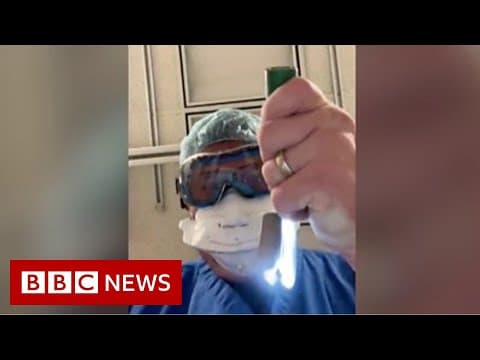
Context: BBC News: "This is what it looks like when you breathe 40 times a minute, have an oxygen level that's dipping well below 80..." Notice the voiced ⁄ð⁄ and lengthened vowel ⁄briːð⁄.
Definition: Take air into the lungs and expel it; inhale and exhale.
Acoustic Audio Comparison: Voiced vs. Voiceless TH
Compare the audio samples below. Notice how the breath escapes softly in "think" and "breath", while "this" and "breathe" resonate with vocal tone.
think
Watch in contextWhisper-like air escape: ⁄θ⁄
Clean voiceless friction
Voiceless dental fricative ⁄θ⁄. Only quiet air flows across the tongue; the vocal cords do not vibrate at all.
this
Watch in contextBuzzing vocal cords: ⁄ð⁄
Buzzing dental friction
Voiced dental fricative ⁄ð⁄. The vocal cords buzz with tone while the tongue maintains the same dental contact as ⁄θ⁄.
breath
Watch in contextShort vowel + unvoiced ⁄θ⁄
Short vowel + unvoiced ⁄θ⁄
Noun: Ends in a voiceless ⁄θ⁄ with a short ⁄ɛ⁄ vowel sound ("BRETH").
breathe
Watch in contextLong vowel + buzzing ⁄ð⁄
Long vowel + buzzing ⁄ð⁄
Verb: The final "e" triggers a long vowel ⁄iː⁄ and transforms the ending into a voiced ⁄ð⁄ ("BREETHE").
clothes
Watch in contextCommonly simplified to "close"
Full ⁄ðz⁄ cluster or simplified
A notoriously tricky cluster. In rapid native speech, it is frequently pronounced identically to the word "close" (⁄kloʊz⁄).
Eliminating S, Z, and D Replacements in Conversation
If you tend to say "dis" instead of "this", you are stopping the air like a plosive consonant. Keep the air flowing like a tire leak. If you tend to say "zis", your tongue is curled too far backward; bring it forward to touch the teeth directly.
Key Takeaway
With just a few minutes of daily tongue positioning practice, dental fricatives will feel completely natural, eliminating one of the most recognizable non-native accent markers.

Dr. Sarah Jenkins
AuthorLinguistics & Phonetics Specialist
PhD in Applied Linguistics with 12+ years researching second-language phonological acquisition and speech cadence.